Welcome to the Cosmic Calendar!
This is a space for astronomy that looks into the night sky as a living language of rhythms and presences. "How big, how far, how fast, how much"… is just the beginning. We give astronomical facts meaning so we can better understand life above and between us.
— Sabrina Dalla Valle, Senior Cosmic Analyst
Key Skywatching Highlights for May 2026
These indications are for North America EST. Remember to always check your actual location for timing and visibility.
This month I thought we’d trace the moon…because it’s a special double moon month, and sometimes its nice to get in sync with the moon’s path and its constantly changing timing as it passes us by.
May 1: Full Flower Moon in Libra
Catch it on the moonset at dawn and then later on the moonrise after dusk. For us in St Petersburg, the rising time is 8:20pm. The actual moment of full moon will be 13:23 EST, smack in the middle of the day. This will be a micromoon at apogee, the furthest point away from Earth making it appear small. In fact, the moon will be about 14% smaller and 30% dimmer than when it is closest to the Earth at perigee.
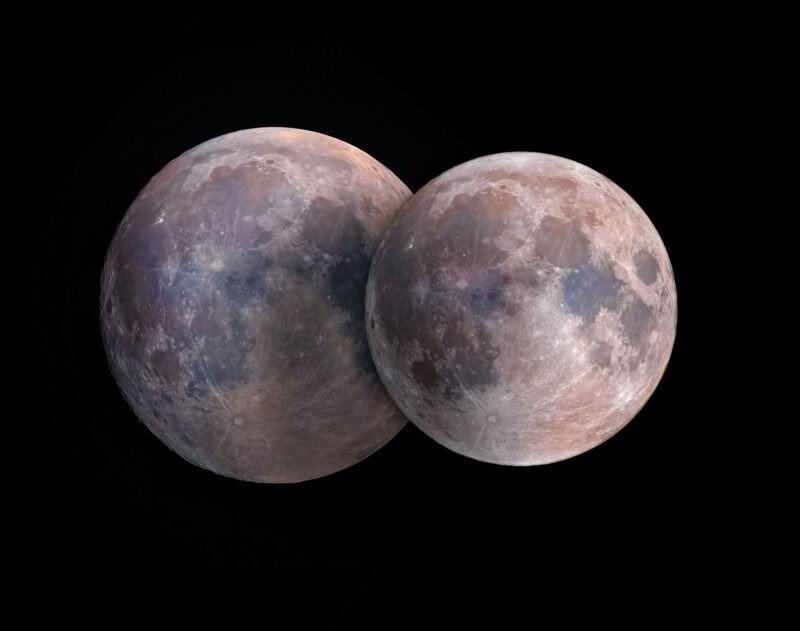
Supermoon Micromoon by Soumyadeep Mukherjer
As we move closer to the summer solstice, the moon will start to trace a lower arc in the sky. The moon follows an inverse path to that of the sun. They teeter-totter each other across the year. So in winter when the Sun is low, the moon path is high and vice versa.
Since we begin the month with a full moon, and it takes about 29 and 1/2 days between each full moon, we are lucky to have a second moon on the last day of the month. A second moon is called a blue moon. These occur every 2 to 3 years. The next blue moon will rise on New Year's Eve 2028.
May 3-4: Moon Conjuncts Antares
The waning moon rises later each night, by now it sits 1.2° south of Antares, the heart of Scorpius, near midnight in the southeastern sky. Both celestial bodies will be at their highest altitude above the southern horizon in the morning of May 4 before dawn.
May 6-7 Moon Conjuncts Sagittarius
Best time to see this conjunction is around 3-4:00am when this constellation is the highest in the sky. The moon will be inside ‘the teapot’ of Sagittarius, located about 30 degrees above the southern horizon.May 9: Third quarter Moon Conjuncts Capricorn
The moon is rising around 02:00 now and setting in the middle of the day. In the early morning before dawn, look for stars in the shape of an arrowhead to find the constellation of Capricorn. This one is a little harder to see and will be faint because of the glow of the Moon which is rising in the sky.
May 13: Moon conjunct Saturn
The moon is dwindling, rising around 04:00 and coming close to Saturn in Pisces on the eastern horizon before dawn.
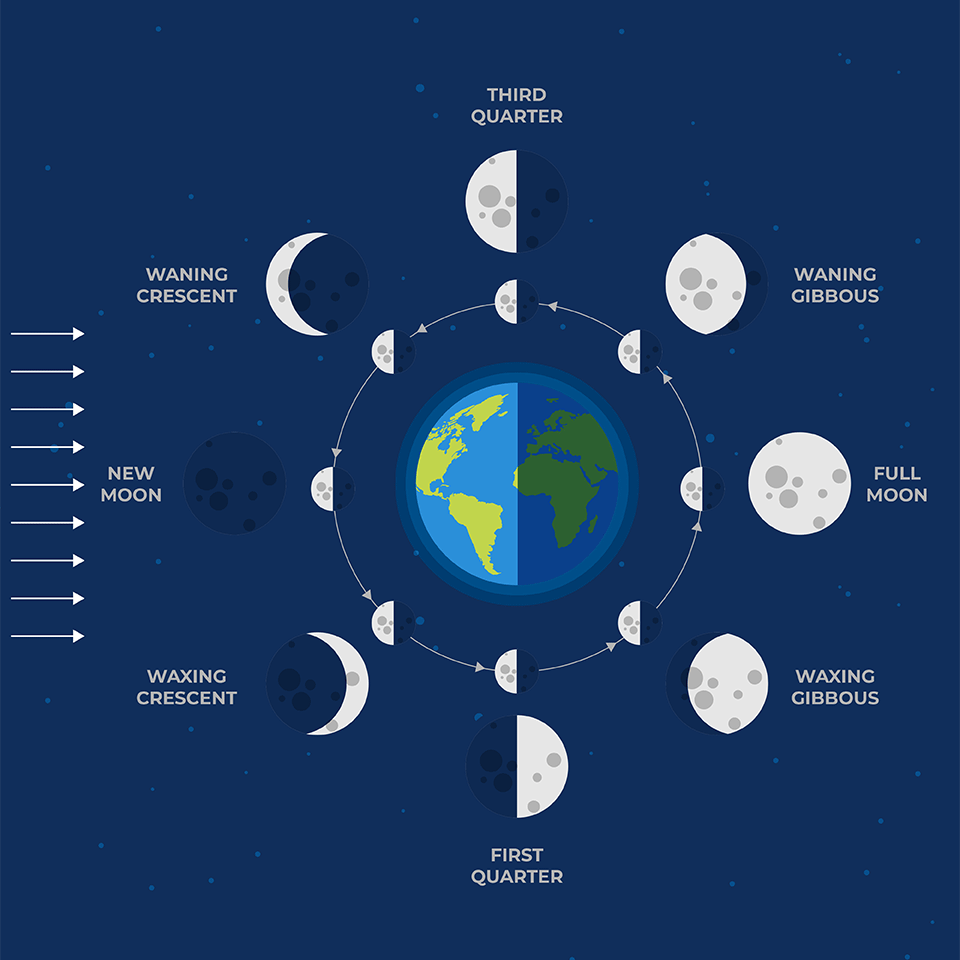
Moon Phases from photographylife.com
May 14: Moon near Mars
The moon is rising very early in the morning and setting a few hours before sunset. It is now a very small sliver of a daytime Moon! Mars is getting stronger and will soon overtake Saturn, climbing a little higher every day in the Eastern sky before dawn.The tiny crescent Moon sliver is now visible near Mars for a few hours before the sun rises
By the middle of May... we start to get a good view of Scorpius to the South in the early morning before dawn. Scorpius is a gatekeeper for the core of the Milky Way which follows immediately to the east. The best months to view the constellation are July and August; it is at its highest point around 21:00 in mid-July.
May 16: New Moon
We will have a beautiful dark sky for sky watching all night long, as the moon is hidden by the Sun moving together on this day right into the constellation of Taurus.
May 18: Moon conjuncts Venus
As the Moon starts to grow again, it rises later and later in the day and sets later in the night. By day 2, it is close to 6% waxing. You will see it right next to Venus in the West as it begins to get dark at dusk until around 22:15 (depending on your location) when Venus finally sets under the horizon. The Moon follows Venus swiftly on her tail disappearing under the horizon a half hour later.
May 20: Moon conjuncts Jupiter
Getting a little bigger and climbing a little higher now, the crescent Moon sits near Jupiter in the constellation of Gemini towards the west and sets at midnight.
May 22-23: Moon Conjuncts Regulus
By now at first quarter, the Moon rises after the noon hour and sets after midnight. Each day, as it rises and sets later and later, it moves along the Zodiac, now passing from Gemini through the smaller constellation of Cancer into Leo. Tonight the Moon will be visiting Regulus--- the heart of the Lion (see our archives for more on Regulus). This constellation will be descending towards the west after dusk.
May 26-27: Moon Conjuncts Spica
As the moon swells into its fullness, it leaves Leo and moves into Virgo. Here it meets up with the brilliant star Spica which represents the ear of wheat held by the virgin in this constellation.
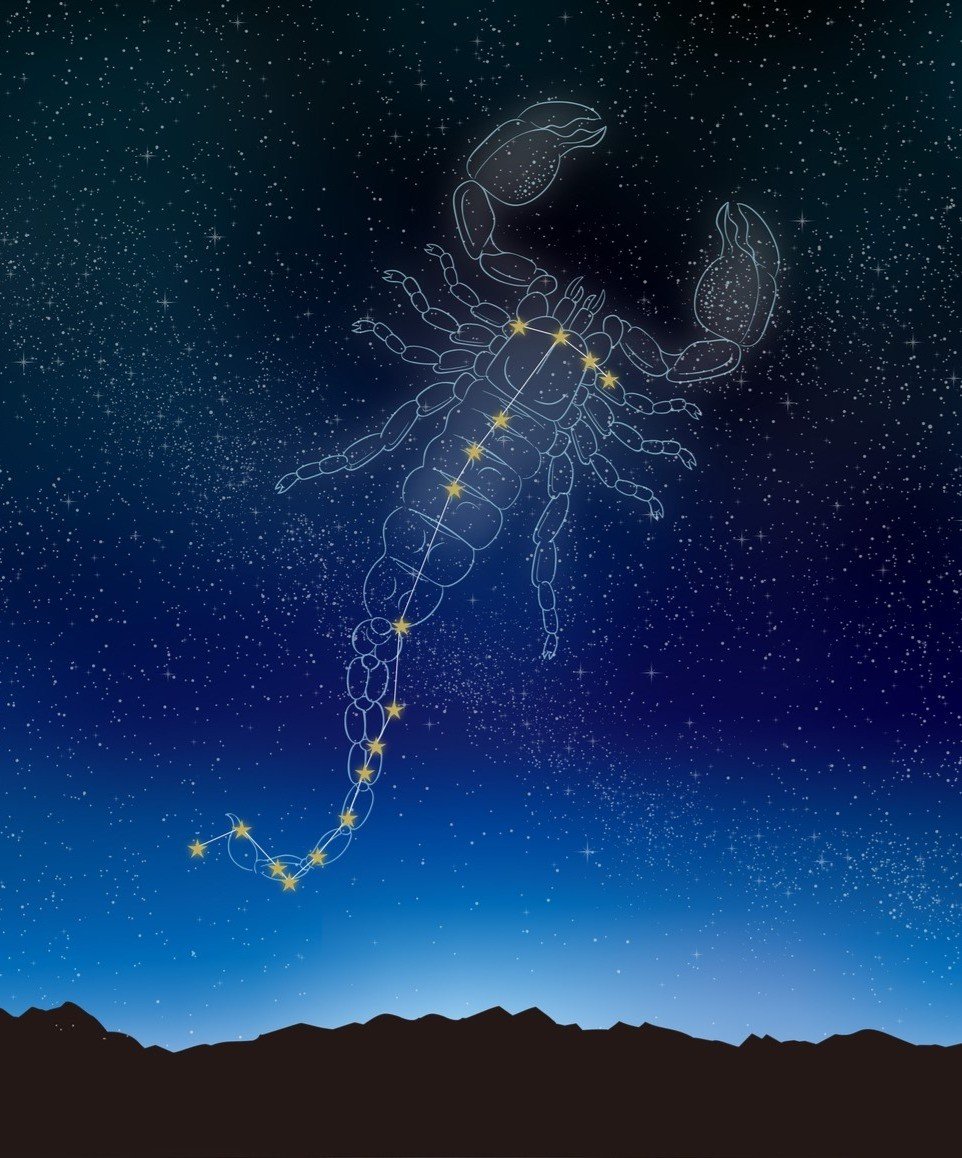
Scorpius in May
May 30-31: Blue Moon in Scorpius
Ahhh… now we come to the end of our cycle where the Moon is opposite the Sun again, which means it now rises as the Sun sets. This is a beautiful picture of balance and connection, each orb in its fullness facing the other upon the visual horizon of the Earth. The ‘three’ become ‘one’. This time we have an even lower altitude micro Blue Moon that has moved into the constellation of Scorpius passing right near Antares ---the Scorpion’s heart. The crest of the full moon happens as the night passes over into the next day, late at 02:45 EST on May 31.
Another significant event is happening tonight, Mercury re-emerges in the evening sky setting 2 hours after the Sun!
Sources